A string in the labyrinth

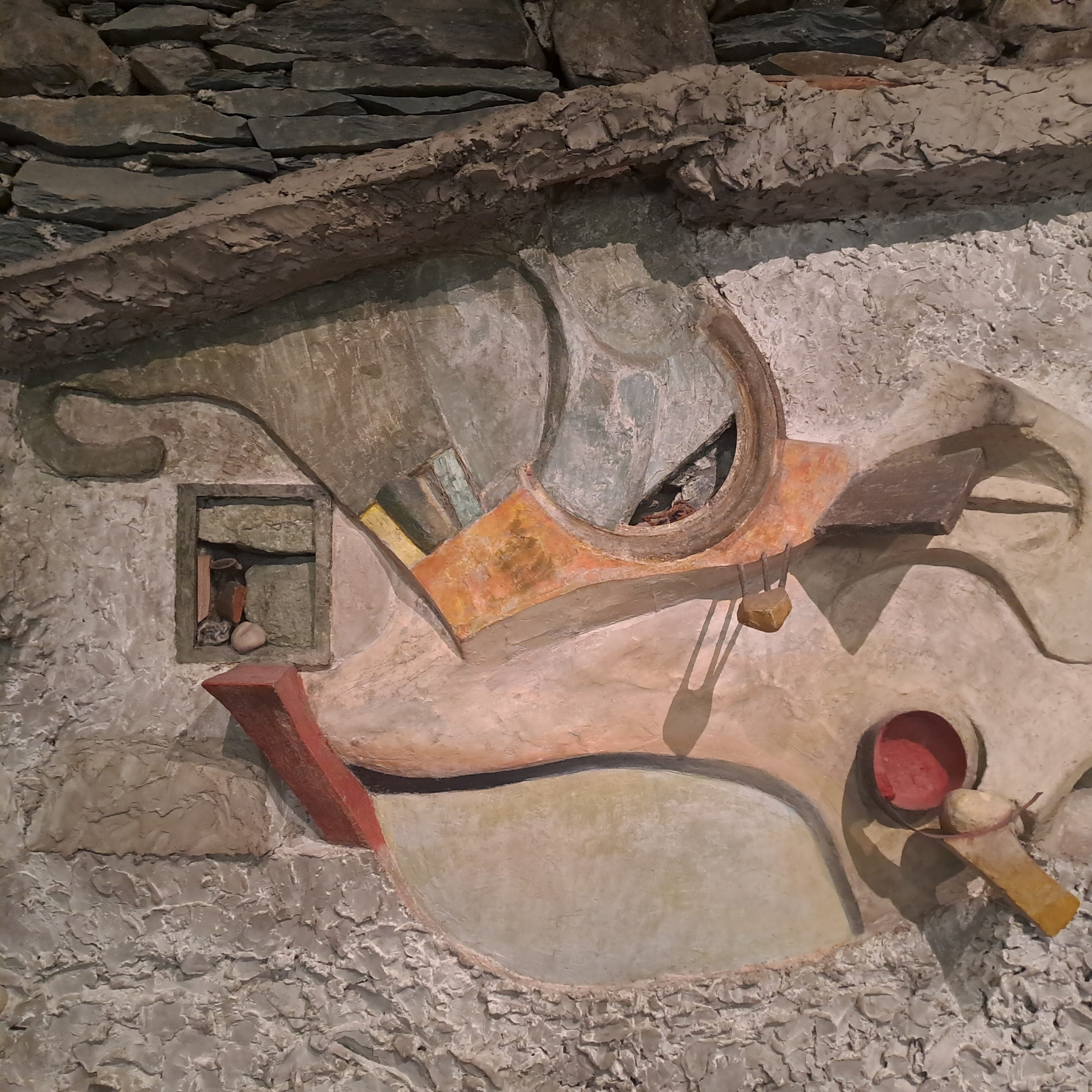
Kurt Schwitters, Merz Barn Wall
Whenever I return to the North-East of England where I grew up, I make a pilgrimage to a fragment of wall preserved in a quiet corner of the Hatton Gallery in Newcastle-upon-Tyne. In this region of ancient military walls, it is a modern ruin constructed in spite of war.
By the summer of 1947 when Kurt Schwitters was working on the slate barn in Ambleside, the German artist had experienced displacement and exile, and he was living in poor health and poverty. It was a decade since he had left Germany, where his work was labelled Degenerate by the Nazi regime; on arriving in England, he had spent 18 months interned as an enemy alien. What did the shelter of this isolated, unseen barn in Cumbria represent?
Schwitters wrote in 1919: Merz painting does not only make use of paint and canvas but of all materials visible to the eye, and of all necessary tools… The wheel of a pram, wire mesh, a piece of string, and cotton wool are all elements that are equal to paint. The artist creates by choosing, distributing and defining material.
I am moved by the singular vision of this unfinished project, and also its painstaking recreation by later artists and curators who believed in preserving Schwitters’ work. Through these acts of attention, a damp decrepit barn has become a vessel in which transformation of everyday objects occurs, in the shaft of light falling from a roof window. I am reminded of other small yet resonant spaces of creative reclusion, such as contemporary artist Lucy May Schofield’s site-specific installation Weak from Dreaming, a one-person observatory located in a derelict shooting hut, on the Highgreen estate in Northumberland. Or the Hōjōki by Kamo no Chōmei, a twelfth-century court poet who in his fifties retreated to Mt Hino, continuing to bear witness to his troubled times from a ten-foot-square hut.
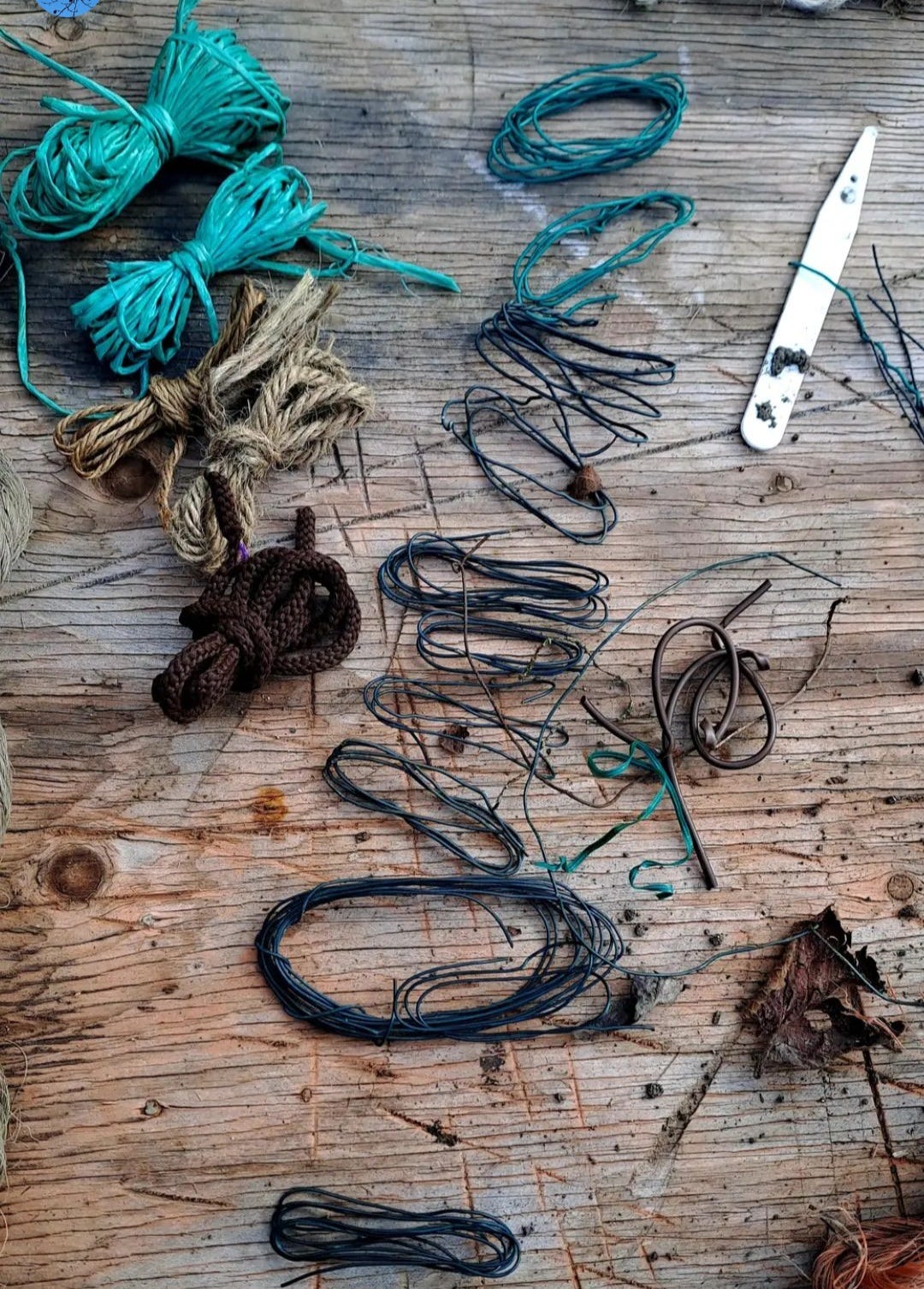
String and twine by the canal
Each of these works has helped guide my own reflections while living in a caravan in the woods since 2021: how to maintain creative integrity among the loud voices of commerce, and considering the merit of working under the radar and beyond the mainstream.
How we choose, distribute and define our material as important now as in Schwitters’ lifetime. Through recent strife, I’ve questioned social media for both personal and ideological reasons. Yet it feels hopeful to maintain a conversation with the wider world beyond my borrowed woods. I enjoyed writing a blog, in the distant, pre-Twitter past - will this Substack pick up where that bit of string left off? Welcome to my labyrinth, who knows what we’ll discover.